


Plant Music
Overview
This device grew out of my interest in climate change and the role of nature and ecology within that problem. From the beginning, I wanted to draw attention to the fact that the natural world around us is living and constantly changing, and to help viewers develop a sense of curiosity and connection to plants by experiencing their activity in a more tangible way.
I designed and engineered an electronic device that measures changes in plants' electrical activity and translates them into generative ambient music. Because each plant has different physical structures and patterns of water and ion movement, their signals can produce different musical behaviors. Plants with faster internal activity and more variation can generate faster, more unpredictable melodies, while plants with slower or more stable signals tend to produce slower melodies with fewer variations. The system does not measure a single isolated plant function; instead, it responds to changes in electrical conductivity associated with processes such as the movement of ions across cell membranes. The plant becomes part of the circuit, acting as a variable resistor whose changing resistance affects the electrical signal and, consequently, the music. Touching or otherwise interacting with the plant can therefore leave a visible imprint on the resulting sound, connecting human actions to the living system.
The Arduino analyzes both small natural fluctuations and larger changes in the signal, translating them into MIDI notes and musical parameters such as pitch, velocity, and duration. The MIDI data is then sent to Pure Data, where it is transformed into sound and processed through oscillators, envelopes, and reverb before being sent to the speakers.
Goals
Technical: The major technical goal was to build a stable system that could operate consistently in real time without requiring complicated manual calibration. In the earlier version, I had to adjust thresholds manually for different plants and electrode positions, so one of my priorities was to make the system more adaptable. The final system can run continuously for multiple days and can be recalibrated for a different plant with the press of a button, allowing it to adapt to changes in the plant or electrode placement without modifying the code.
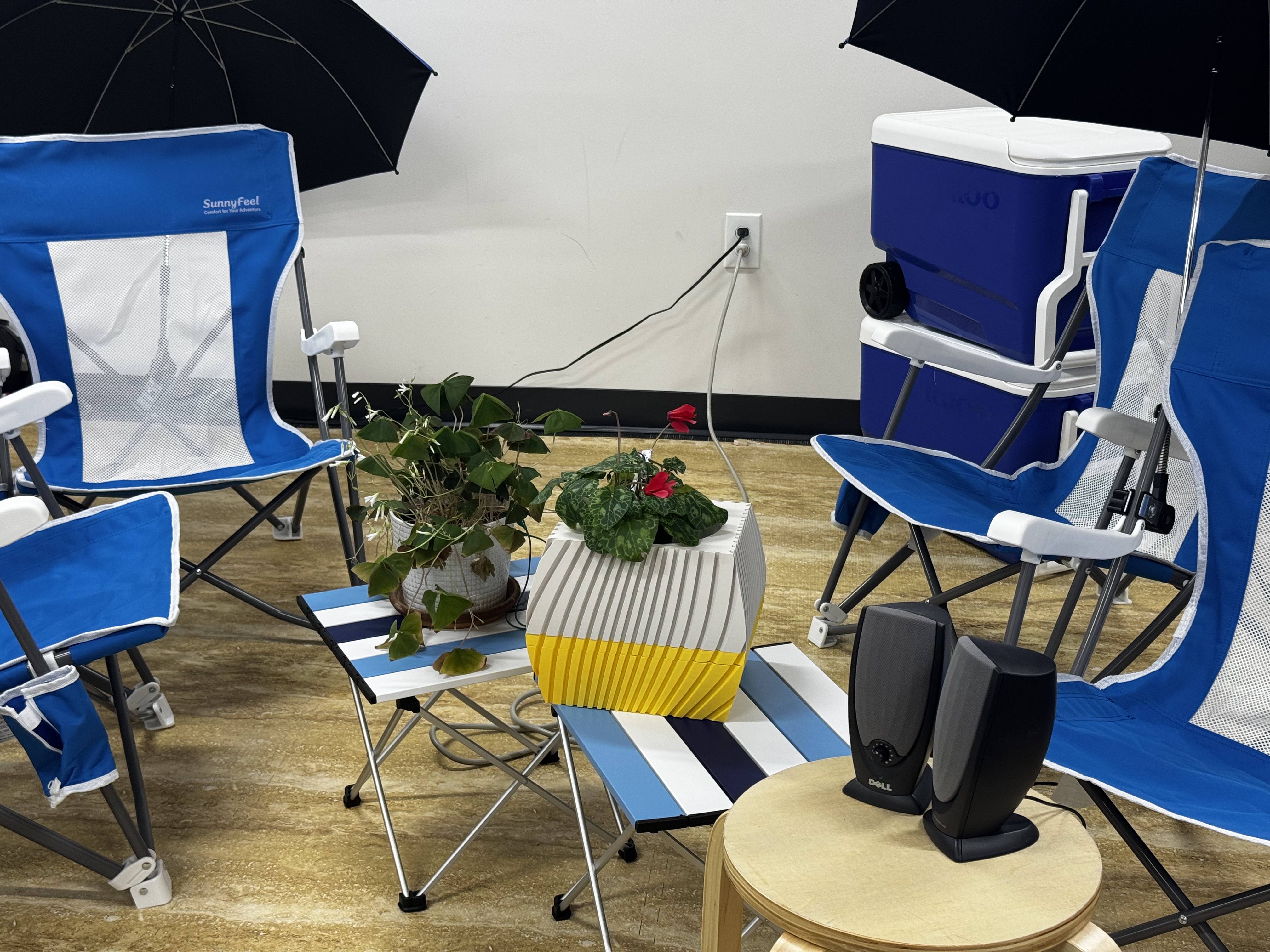
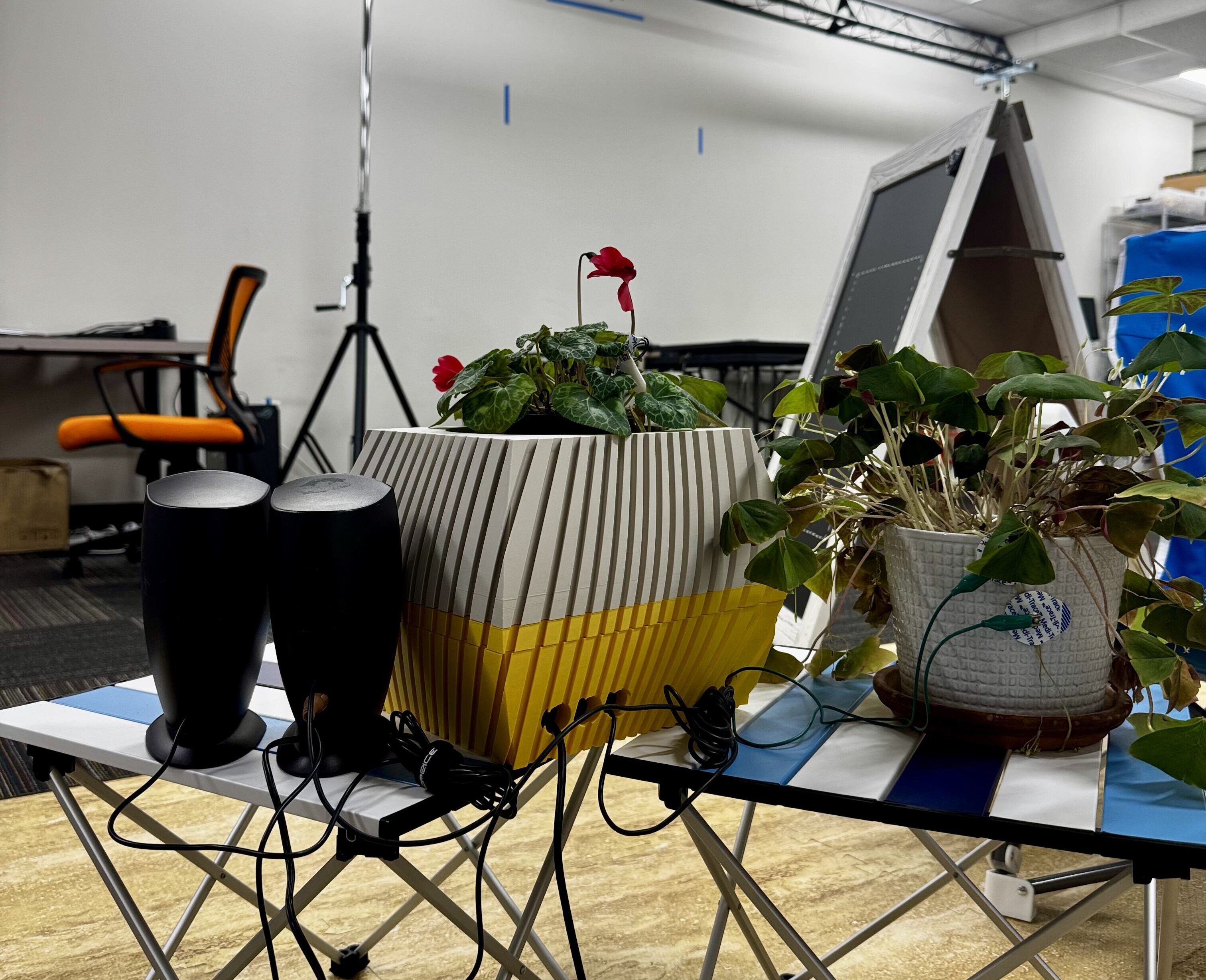
Conceptual: From the conceptual and experiential standpoint, I wanted to create an interaction that was engaging, enjoyable, and meaningful. The finished design incorporates two plants, allowing visitors to physically interact with living organisms while hearing their activity translated into sound. This creates two connected forms of interaction: kinesthetic interaction through touching and engaging with the plants, and audio interaction through the resulting generative music. I wanted the sound to feel calming and immersive while still making the visitor aware that their actions can influence the plant and the resulting composition.
Integration: Another major goal was to move the project from a functional prototype toward a finished installation. For this version, I wanted the technology to become integrated into the physical object rather than remain the focus of attention. I therefore designed and 3D-printed a custom housing for the pot that conceals the electronics, provides access for maintenance, routes the necessary connections, and incorporates the plant into the overall form. This combination of electronics, software, sound, and physical design was an important part of making the project feel like a complete installation rather than a collection of separate technical components
Process
Building a Circuit
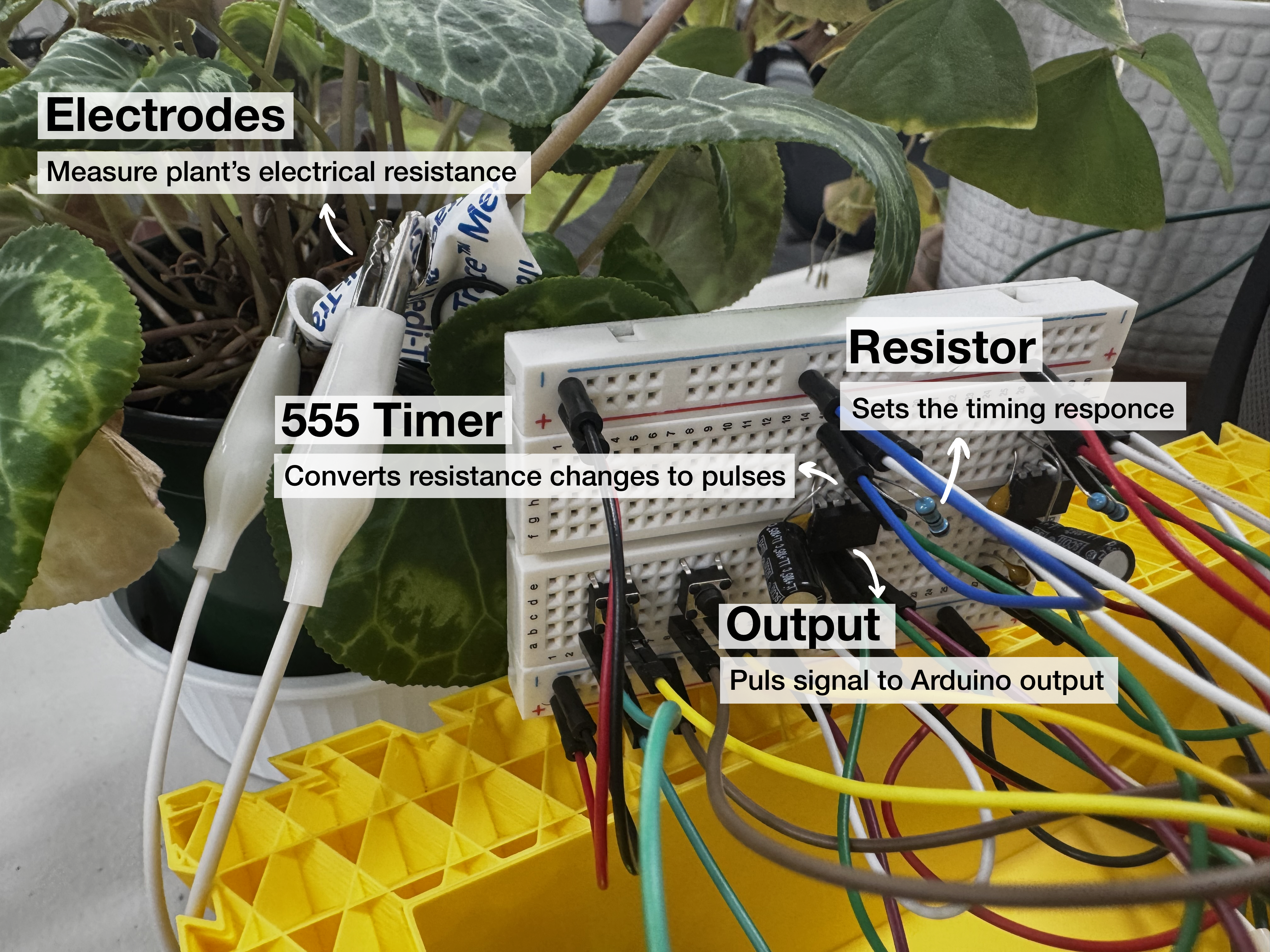
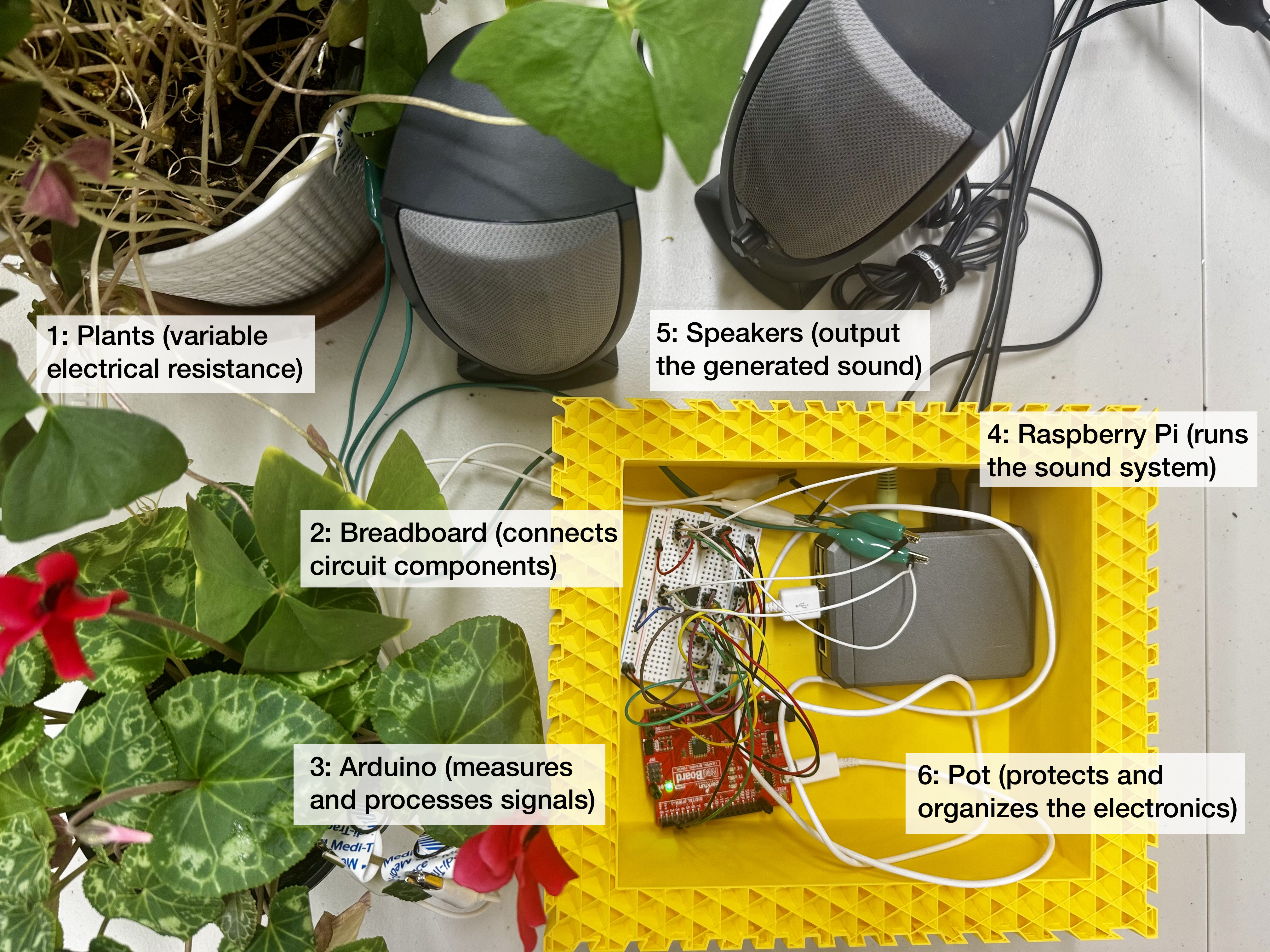
The circuit is built around a 555 timer, which converts changes in the electrical resistance of the plant into a series of electrical pulses. The plant acts as a variable resistor: when the plant's electrical conductivity changes, the resistance in the circuit changes, which in turn changes the timing of the 555 timer's output pulses. These pulses are sent to the Arduino, allowing it to measure the changing electrical activity of the plant. The Arduino measures the time between consecutive pulses using its interrupt pins. Separate inputs are used for the two plants, allowing each plant to be monitored independently.
Signals transformation C++
The Arduino receives the pulse signals generated by the 555 timer and measures the time between consecutive pulses for each plant. It collects a series of pulse intervals and calculates several characteristics of the signal, including the average value, range, and standard deviation. These measurements allow the program to distinguish normal fluctuations from larger changes in the plant's electrical activity. A threshold and cooldown system are used to prevent small fluctuations or very rapid changes from producing too many notes, making the musical response smoother and more stable.
The measured signal is then mapped to musical parameters. The average pulse value determines the pitch within a defined note range, with Plant 1 using a lower register and Plant 2 using a higher register. The resulting notes are constrained to a pentatonic musical scale. Larger changes in the signal affect the MIDI velocity and duration, while unusually large variations can trigger chords instead of individual notes. The two plants are assigned to separate MIDI channels so their musical responses can be processed independently.
The resulting MIDI messages contain the note, velocity, duration, and channel information and are sent from the Arduino to Pure Data.
Audio Environment in PureData
Pure Data separates the two channels and uses the MIDI parameters to control the sound-generating processes. The note controls pitch, velocity controls the intensity of the sound, and the duration value is used to shape the sound envelope. The sounds of two plants combine and a reverb is added to make the melody more ambient. Each plant therefore follows the same basic signal-conversion process while producing a distinct musical register and sound layer.
Midi Connection and Raspberry Pi
After testing everything, the Arduino is connected to the Raspberry Pi, which acts as the central computer for the audio system. The Arduino sends MIDI data through USB, while the Raspberry Pi runs Pure Data and handles the real-time generation and processing of sound. I used ttymidi to bridge the Arduino's serial MIDI data into the JACK audio environment, allowing the MIDI messages to be received by Pure Data.
The Raspberry Pi also handles the final audio output. JACK is used to route the audio generated by Pure Data to the stereo audio output and speakers. Setting up this part of the system required troubleshooting the communication between the Arduino, MIDI routing, Pure Data, and the audio hardware. The final setup allows the entire system to run independently without requiring a computer to manually control the installation. Once powered on, the system can receive signals from both plants, translate them into sound, and continuously play the resulting ambient composition in real time.
Pot Design & 3D Printing
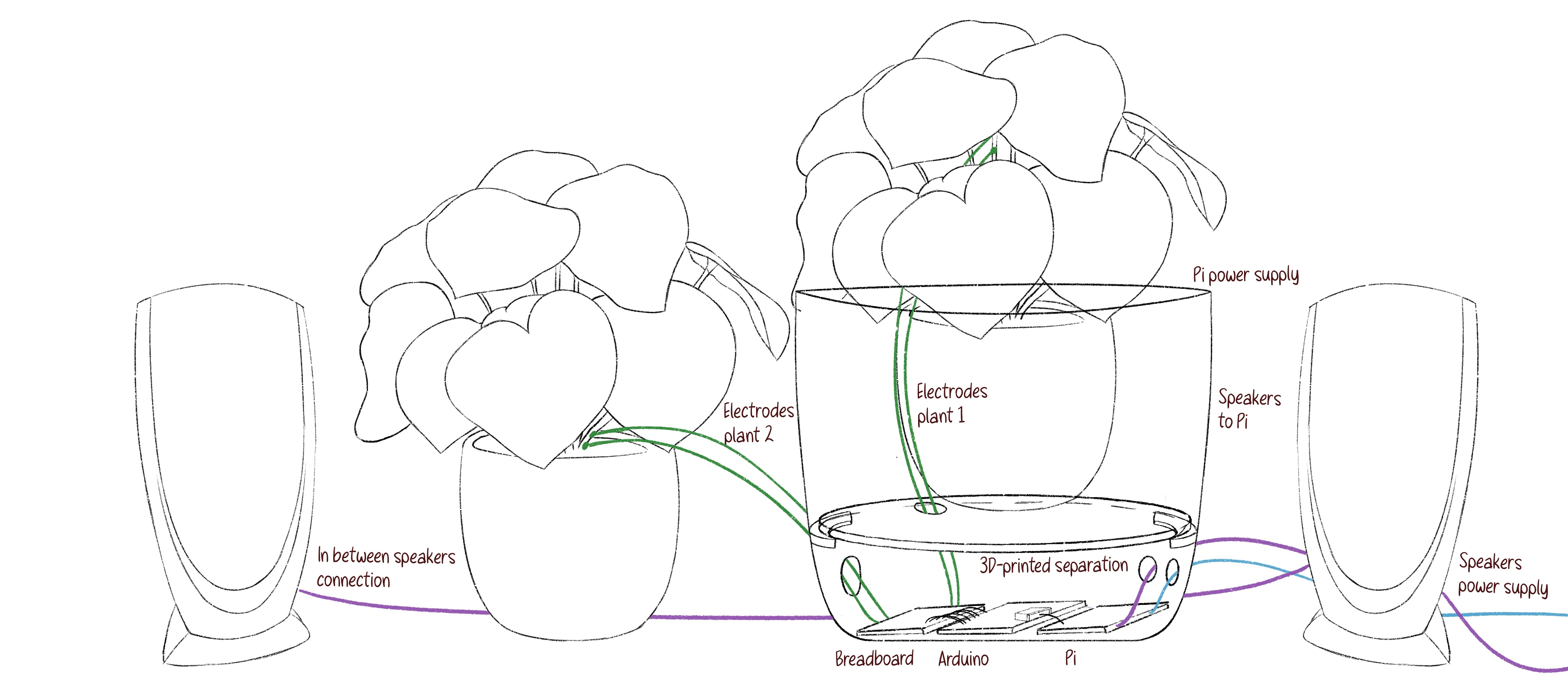
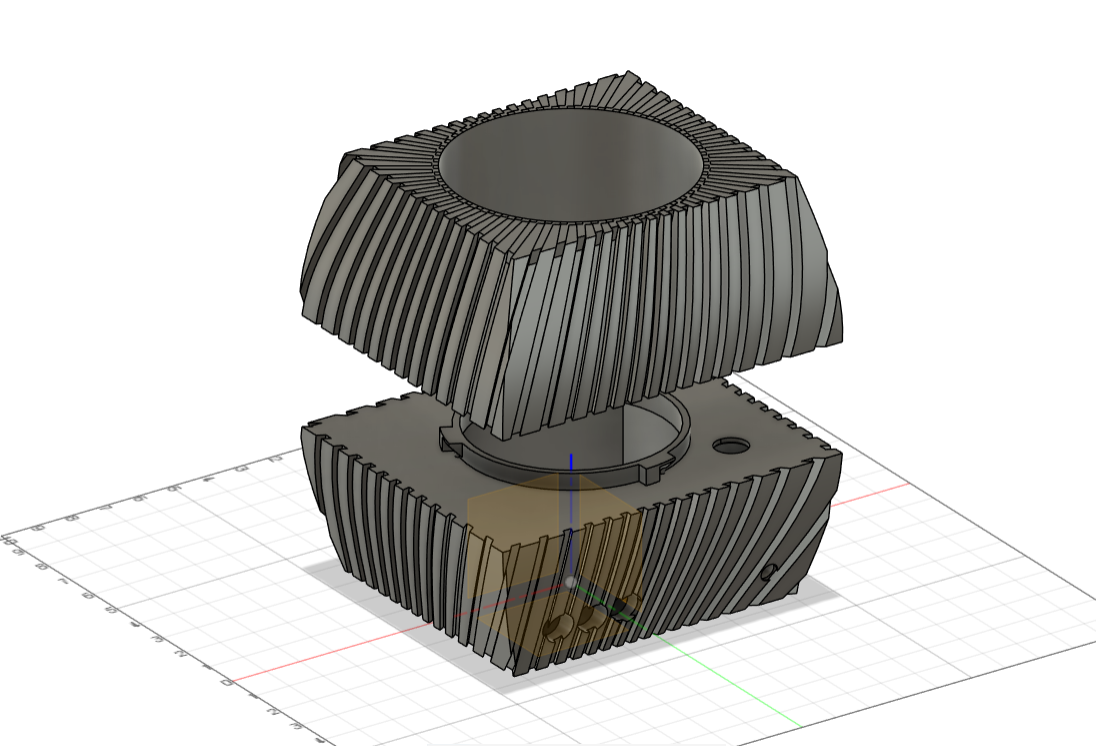
The final housing was designed as a custom two-part pot that integrates the electronics into the physical form of the installation. The lower section houses the larger electronic components, including the breadboard, Arduino, Raspberry Pi, and associated wiring. I designed openings and internal channels into the structure to route connections to the speakers, power supply, and electrodes attached to both plants. This keeps the technical components concealed while still allowing access for assembly, troubleshooting, and maintenance.
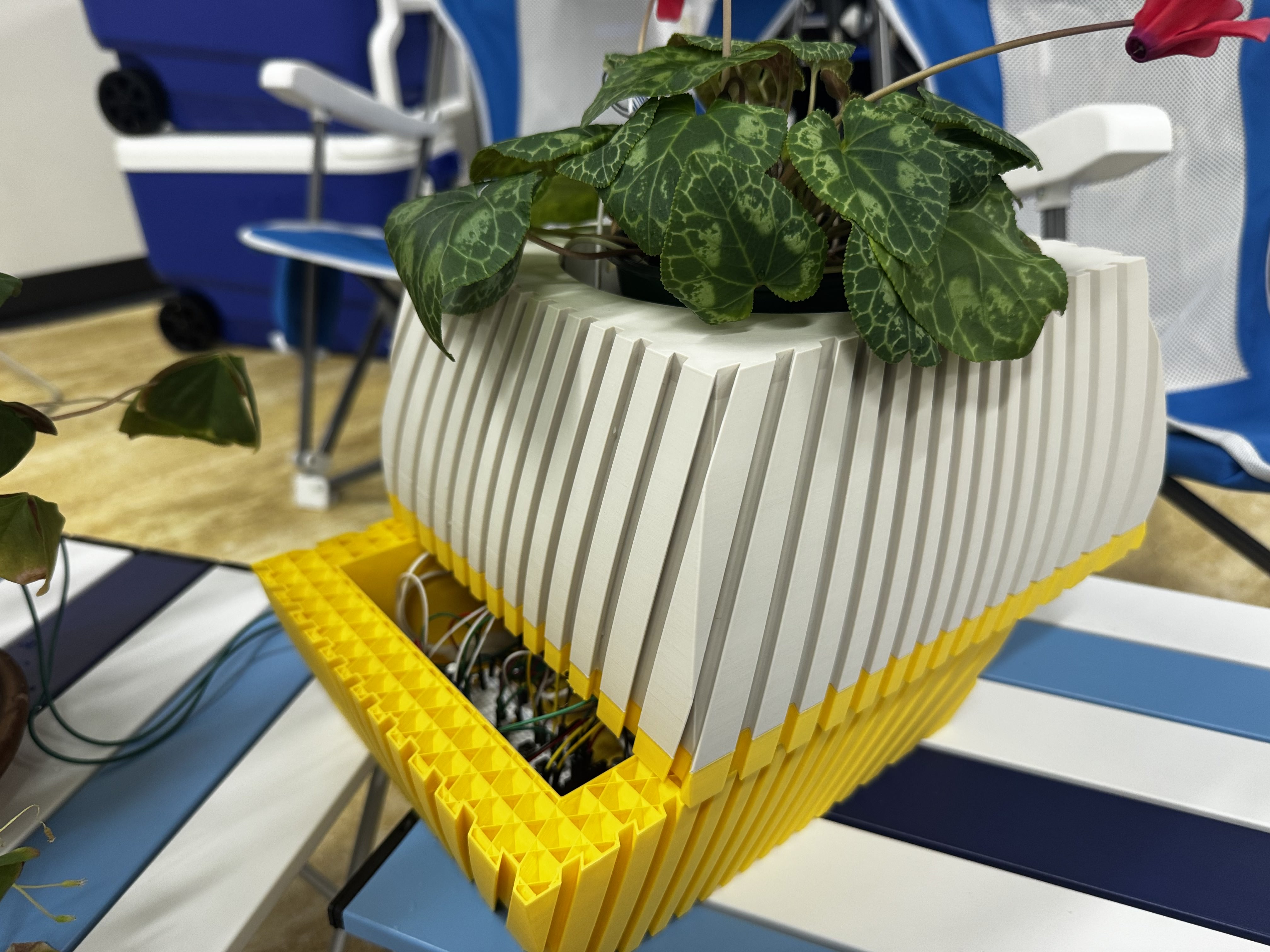
The upper section separates the plant from the electronics and provides a solid platform for the plant to sit on. The two sections connect through a twist-and-lock mechanism, allowing the upper section to be securely attached during use and easily removed when access to the electronics is needed. The connection also makes it possible to transport the pot as a single unit. I designed the exterior relief to continue across both sections, so when the pieces are assembled, the pattern aligns and reads as one continuous surface rather than two separate parts.
Designing and 3D printing the housing was an important step in moving the project from a functional electronics prototype toward a finished installation. Instead of having exposed components, breadboards, and loose wires, the technical system becomes integrated into the object itself. This helped shift the focus from the technology to the plants and the resulting interaction and sound.
Challenges and Learning Outcomes
Calibration and Automation
One of the main challenges was making the system adaptable to different plants and electrode positions. In the earlier version, I adjusted threshold values manually in the code, which was time-consuming and required repeatedly reattaching the electrodes and finding a position that produced useful readings. I addressed this by developing an automatic calibration process. When calibration is triggered, the system collects 10 seconds of data while the plant is in a stable state, calculates its typical signal characteristics, and uses those values to determine when future changes are significant enough to influence the music. A physical button allows the system to be recalibrated at any time, which is useful when changing plants, repositioning electrodes, or when environmental conditions change. This made the system much more practical for a real installation and reduced the need for manual adjustment.
Understanding Plant-Specific Signals
Another major learning outcome came from testing the system with different types of plants. I learned that the quality and consistency of the signal depends strongly on the plant's physical structure and how water and electrical signals move through it. For example, plants with very thick stems and leaves, such as palms, tended to produce smaller changes and therefore generated slower and more monotonous musical responses.
Through experimentation, I found that smaller houseplants, such as violets, produced more useful and consistent results for this system. I also found that placing the electrodes relatively close together, such as on the same stem, produced a more stable baseline while still allowing larger changes, such as touching the plant, to be detected even when the interaction happened elsewhere on the plant. This testing taught me that the electronics and algorithm cannot be completely separated from the physical characteristics of the organism being measured. In the future, I could extend the system by creating plant-specific presets that adjust parameters such as threshold, sample size, and sensitivity based on the type of plant being used.
Comparison of signals from leafs vs stems. The threshold and sample size values are identical. The electrodes locations are different:
Integrating a Second Plant
The original system was designed around a single plant, so adding a second plant required changes to both the Arduino code and the Pure Data environment. I restructured several functions so that the same processing logic could be applied independently to multiple inputs, while assigning each plant its own MIDI channel. In Pure Data, the two channels are separated and processed through their own instruments before being combined into a shared audio environment and reverb.
This process helped me understand how to design the system in a more modular way rather than creating separate code and audio processes for every plant. The current structure works well for two plants and could be expanded further, although an installation with more than approximately five plants would benefit from a higher level of abstraction.

